Move mouse over sketch above to view labels. Click image for larger version.
Observation Notes:
While making my way to M104 last week, I ran across this startling multiple star. I had read about "The Stargate", but wasn't counting on seeing it that night. The nearly symmetrical arrangement of the nested triangles is hard to miss, and difficult to peel my eyes away from once I saw it. One thing that I also noticed was the beautiful colors the stars appeared to display. The two bright central stars seemed to trade yellow and blue back and forth between each other. I finally settled on yellow for the southern and blue for the northern. The fainter star in the inner triangle appeared dull orange.
After preparing a sketch, I went to work with the astrometric eyepiece. The problem was I wasn't sure which star was the primary. I decided I'd use the bright, outer, southern star as primary. I was wrong. The southern inner star is considered the "A" star. After discovering this difference a few days later, I decided to transfer my measurements using my digital sketch as a measuring tool. I positioned the stars in my digital sketch using the original measurements I took. I then re-measured them from the correct A star with the tools Photoshop supplies. Most of my extrapolated measurements correspond nicely with 1998 values from Double stars in astrometric catalogs (Wycoff+, 2006).
Don't miss this incredible, colorful multiple star!
Subject
STF 1659 (The Stargate)
Classification
Multiple Star
Position (J2000)
Corvus [RA: 12:35:43.5 / Dec: -12:01:29]*
Position Angle*
AB: 354° [2008.5 my measurement] || 351.1° [1998.25 TMA2003]
AC: 63° [2008.5 my measurement] || 69.4° [1998.25 TMA2003]
AD: 34° [2008.5 my measurement] || 31.4° [1998.25 TMA2003]
AE: 274° [2008.5 my measurement] || 275.2° [1998.25 TMA2003]
AF: 138° [2008.5 my measurement] || 140.1° [1998.25 TMA2003]
Separation*
AB: 28" [2008.5 my measurement] || 27.57" [1998.25 TMA2003]
AC: 46" [2008.5 my measurement] || 42.2" [1998.25 TMA2003]
AD: 198" [2008.5 my measurement] || 188.98" [1998.25 TMA2003]
AE: 149" [2008.5 my measurement] || 154.72" [1998.25 TMA2003]
AF: 208" [2008.5 my measurement] || 207.23" [1998.25 TMA2003]
10 mm Sirius Plössl + 2X Barlow (240X) 12 mm Meade Astrometric EP + 2X Barlow (200X)
Conditions
Clear, breezy, pleasant
Seeing
6/10 Pickering
Transparency
NELM Mag ~5.0
*References
The Washington Visual Double Star Catalog, 1996.0 (Worley+, 1996); Double stars in astrometric catalogs (Wycoff+, 2006); The Tycho-2 Catalogue (Hog+ 2000); SIMBAD; Starry Night Pro Plus 5.8
Advanced Observer's Program at Kitt Peak National Observatory
On the evening of Sunday, June 8th, I had the pleasure of visiting Kitt Peak National Observatory and participating in the Advanced Observer's Program--an overnight observing session with one of the program's RC telescopes. I attended with four friends, Curt, Rob, Brazos, and Ken. Curt was the mastermind of the trip, and I had the privilege of being the tour guide. We were assisted all night by our friendly scope operator, John Zum Brunnen.
Because the five of us were attending a convention in Tucson, we weren't able to get to the observatory until about 7:00 pm. That meant we missed the early dinner that normally goes along with the program. But we found John, and he showed us to our dorm rooms and then the cafeteria where we ate our midnight meals a few hours early. The cafeteria was nicely stocked, by the way, and the meals were great.
We were not able to head straight to our dome to observe, however. The way the program is structured, we needed to wait for the Nightly Observing Program to end at about 10 pm (since they use the AOP scopes to tour the NOP attendees). This wasn't a big deal, since the five-day-old moon was lighting things up nicely. While we waited, I set up my 8" Dobsonian and 15x70 Oberwerk binoculars for some casual observing at the Visitor Center patio. We shared the spot with a couple German visitors who had broken away from the NOP group to take some long exposures of the Milky Way rising over the striking National Solar Observatory to the east. We checked out some brighter objects such as M4, Omega Centauri, M8, M57, the False Comet in Scorpius, a squirming low-altitude Jupiter, and of course the Moon.
Before long, John showed up to lead us to the 16-inch RC dome. The scope was housed up a curving stairway at the top of a roll-off roof structure. It was spacious enough that the six of us easily fit with room to maneuver back and forth to the eyepiece. The 16-inch Ritchey-Chretien scope is well-suited for astrophotography, but we were there to enjoy visual observing: and it was excellent. Straining for detail through my 6-inch scope made galaxy details in the RC a delight--M51's arms looked like a pair of sturdy ropes!
John pointed the scope for us by using a computer at one end of the room. Although the computer was operated in 'dark' mode, the light from the LCD display was still jarring each time he had to flip it on to re-point the scope. It would be nice if GOTO pointing could be handled with a small, dim hand controller. In the end, it wasn't a big problem, since we weren't really hunting extremely faint objects that would call for well-preserved dark adaptation.
The RC was paired with a TEC APO140ED (140 mm, f/7) refractor. For the first hour or so, we enjoyed comparing views through both scopes, but finally had John attach a Canon 20D to the refractor to snag photos of several objects as we observed them.
Here is a list of what we observed (they are only in rough chronological order):
M51/NGC 5195
Spiral structure was beautifully pronounced. With only a couple minutes of study, I could not convince myself that the "bridge" between the two galaxies appeared complete.
M101
Spiral structure obvious, although still subtle
M104
M84/M86 and Pals
It was fun using the RC joystick to drive around the heart of the Virgo Cluster. NGC 4435 and 4438 showed tantalizing hints of structure that would have been nice to examine further.
M81/M82
M4
M13
M22
M27
The fainter lateral extensions gave the nebula a very pronounced football shape. Beautiful.
M57
M11
Bustling with stars. The dark lanes and v-shaped row of outer stars was very pronounced.
Dark nebulae were crisp and rich with detail. The reflection nebula wrapped itself noticeably around the periphery of the emission lobe.
M17
Richly detailed with scalloping in the brighter portions and delicate feathering in the fainter sections.
M16
More subtle than the previous three, but still loaded with mottling. Searching for the "Pillars of Creation" at 200X showed a very faint, dark intrusion shaped like a pointing hand at the right location. It would not have stood out without close examination of a drawing of the field.
NGC 6520 & B86
Wonderfully detailed view with foaming Milky Way surrounding the cluster and dark nebula
M55
NGC 7789
NGC 6826
Colorful, bright and detailed.
IC 3586
PN does indeed possess the appearance of a slice of lime
Hickson 92
The five brightest members all showed up nicely with just a bit of effort.
M31/M32/M110
NGC 7293
Not much detail at a glance, but looked like it would benefit from some lengthy averted vision study.
NGC 7380
Nebulosity surrounding the OC was elusive and the entire object would have benefited from a wider field.
Jupiter
Great detail, but no GRS or moon/shadow transits.
Uranus
Wonderful to see disc so well resolved and steady.
Neptune
Although smaller than Uranus, disc shape is a pleasant sight.
And here are low-res images of the photos we took home with us:
I'm very slowly working my way through those photos to come up with optimized versions. But since each image is a single, three-minute exposure, eliminating noise is fairly difficult--and I'm no master at astrophoto processing. Still, for three-minute single exposures, they look really good to me. When I get them finished, I'll post the processed versions...(so that you may laugh :-).
The program was very enjoyable, and it was great to see so many showpiece objects through an excellent scope. With five of us observing together, the cost came out to $182 per person. I think it would be nice to try the program again during the winter months to squeeze in a few more hours of darkness and linger on some more wonders of the deep sky.
It's about time I sketched this beautiful, bright galaxy. Once again, I observed from home, which is not the best place to see structure in galaxies--but the Sombrero was very cooperative. It was conveniently aligned at a PA of 90 degrees. The visible extent appeared to be about 1 x 6 arc minutes. At 120X, the sharp drop in brightness along the south edge was picked up again by a subtle, soft brightening. I would not say the dark lane was apparent at this scale, and under these conditions. At 240X however, the dark lane dividing the two regions was visible. The apparent width of this southern section was about 3 arc minutes.
The heart of the galaxy was punctuated by a stellar core. At 120X, this core appered to be at the edge of the dark lane boundary. At 240X, it was definitely separated from the dark lane. The dark lane appeared to bow very slightly around the stellar core.
Object Information:
M104, the Sombrero Galaxy, lies about 50 million light years away and is a primary member of the M104 group of galaxies. It is an Sa/Sb type galaxy, seen from about 6 degrees above its equatorial plane. It sports a pronounced dust lane as well as a large population of globular clusters. In 1912, it was found to have a large redshift of 1000 km/sec by V. Slipher at Lowell Observatory. M104 was discovered by Pierre Méchain in 1781.
Deep in the bright heart of the Lagoon Nebula lies a knot of fluorescing gas called the Hourglass Nebula. While observing at Kitt Peak Observatory's Advanced Observer's Program with four good friends, I enjoyed a couple minutes boring into the Lagoon with the 16-inch Ritchey-Chretien. This bright flare was indeed shaped like an hourglass resting on a bed of wrinkled fabric. A bisection occurred where the two halves of the hourglass met, and the western side was bordered by a tri-lobed patch of dark nebulosity. I did not want to hog the eyepiece too long, so I worked up a quick contour sketch of the area and applied shading after returning home. The structure was distinct enough, that I think I should be able to observe it with my 6 or 8 inch scopes--I just hadn't tried before.
My overall M8 observation report and sketches can be found here: M8.
Object Information:
The blazing gases in the Hourglass Nebula are primarily lit by the star Herchel 36, which can be seen in the sketch (nestled in the dark nebulosity to the west of the hourglass). A close-up look with the Hubble Space Telescope shows that the bisection of the hourglass shape is caused by vortices of dust and gas. It is possible that strong temperature gradients and stellar winds could create shearing forces that sculpt the tornadic shapes. However, future observations will be needed to determine velocities and see if this is indeed what is happening.
Subject
Hourglass Nebula (M8)
Classification
Emission Nebula
Position*
Sagittarius [RA: 18:03:41.2 / Dec: -24:22:49]
Size*
-
Brightness*
-
Date/Time
June 9, 2008 - 1:00 AM MST (June 9, 2008 - 08:00 UT)
Any opportunity to head closer to Earth's midsection is likely to get a Northern Hemisphere amateur astronomer salivating at the possibilities. The awesome trip we took to the Caribbean last month brought us down to 19 degrees North Latitude. That's 16 degrees further south than Flagstaff, and very close to what we enjoyed in Maui last year. Unfortunately, cruise ships are not outfitted for the serene contemplation of nature and nighttime wonders. I have read that some stargazers have found dark nooks and crannies to observe from on cruise ships, but I can tell you that I found nothing of the kind on the Carnival Liberty at night. Standing at the railing 100 feet above the frothing ocean, I can appreciate the desire to keep things well-lit. More than once, I considered what it would be like to get disoriented and flop over the railing, never to be seen again. Yikes.
So that was challenge number one: Brilliant, white light shining everywhere
Challenge number two was clouds. It's the tropics after all. And with Tropical Storm Alma stirring things up over Nicaragua, we had more fits of clouds than we otherwise would have.
The third challenge was more of a trade-off than a challenge. And that was all the things to do and enjoy, all day and all night on the ship. Hanging out on the upper deck with a tripod, binoculars and a sketch pad was not top on the list of things I hoped to enjoy with my family! One evening did offer a brief window to scout out a good observing spot to have a look at Centaurus and Carina. I almost type "Milky Way" after those constellation names, but honestly, the Milky Way was only vaguely hinted at through all the glare.
My 15 x 70 binoculars did a fine job though as long as I shielded my eyes from the blazing floor lights. Flickering thunderstorms along the horizon kept me from observing or sketching anything in Carina, so I headed over to Centaurus and enjoyed a long look at Alpha and Beta Centauri before working on a sketch of Omega Centauri. Sadly, I can observe this from Flagstaff, but it was much higher here, and it was safe from the clouds long enough for me to grab it as a consolation observation. It felt good to soak in the starlight and touch pencil to paper. No red light was necessary here! And I could refine the shading on the globular easily and to my satisfaction. The binoculars were also a nice instrument for use on a moving ship. The subtle rocking of the ship was barely noticeable, and no hindrance at all to the observation.
Omega Centauri is a large, soft, obvious puff of light amid a spatter of bright field stars. It possesses a slight elongation, and a softly defined luminosity profile. A few people passed by and asked what I was looking at. Unfortunately, the soft light of the globular is a tough object for the uninitiated, light-blinded public, so I gave the binoculars a brief turn to Jupiter to show off its startlingly linear arrangement of moons before returning to my sketch. After finishing the sketch, I hoped to grab another, but the clouds were closing in rapidly. In the few remaining minutes I had, I was able to enjoy a stunning view of the False Comet in Scorpius before everything disappeared.
Object Information
Weighing in at 5 million solar masses, Omega Centauri is the largest and brightest globular cluster of the Milky Way. It lies 16,000 light years away. A study of 50,000 stars in the cluster show that the member stars formed over a period of 2 billion years and so it contains multiple populations. This leads to the possibility that the cluster is the core of another galaxy that has been cannibalized by the Milky Way.
Until a few weeks ago, I've never made a serious attempt to look for a green flash on the setting sun. My horizons are treed and mountainous. And when I have had access to an ocean or flat desert horizon, there have either been clouds or other things to do.
While on a week-long cruise in the Carribbean last month, one evening offered a beautiful sunset where the distant clouds didn't quite conceal the horizon. I took the opportunity to shoot some photos over the railing to see if several miles of thick, refracting air would throw a green sunbeam at me. It was a beautiful sight, but I didn't see a lick of green. At least that's what I thought. After checking the images when we got home, I noticed my final image had an interestingly tinted sliver of sunlight in it. That last little gasp of greenish light might be a visual contrast effect with the orange sky, but it does measure ever-so-slightly greenish in Photoshop. (I didn't apply any unsharp masking to the photo--but random color noise might play into it.)
ISS and STS-124 (Space Shuttle Discovery) Flyover - June 9, 2008
After seeing the stunning launch of Discovery the week before, I was really hoping to photograph it while it was docked to the International Space Station. We had a very good pass on Monday, June 9, with an 87° culmination. The last time I photographed the ISS, I used my 6" equatorial Newtonian. This time, I tried it with my 8" Dobsonian. The Dob is not equipped with a Telrad finder, so I had to use the standard 6x30 crosshair finder. It wasn't as bad as I thought it would be. The field was wide enough to allow me to lead the ISS easily and funnel it toward the center of the crosshairs. I used a 2X barlow to achieve focus (I can't get prime focus in the 8" scope either), and this also gave me a larger image scale. I set the Canon 300D exposures to 1/1000 second at ISO 1600. The difficulty I ran into this time was getting the remote shutter release to fire the camera when I wanted it. I missed several good overhead shots because the camera didn't fire quickly enough.
Still, a few shots did come out fairly well, and I spent some time trying to identify the shuttle. That's where I got lost. My images are too fuzzy to be able to clearly identify the aspect of the space station or any recognizable shape in the shuttle. The fact that the solar panels change orientation makes it even more difficult to compare the photos to NASA imagery. Fortunately, I was able to pose the question to Ralph Vandenberg, who takes incredibly detailed images of orbiting satellites and who has a much better feel for the geometry of the ISS. He helpfully pointed out where the shuttle was in both images shown above. The first photo shows the pair prior to culmination as they approached from the northwest. The second photo shows them after culmination and heading off to the southeast. I got zero shots when it was almost directly overhead due to a fantastic struggle with Dobson's Hole, and a camera that would not shoot when I wanted it to.
Credit for the labels on the image above goes to Ralph Vandenberg--without whom I would have no idea which blob was what.
Space Shuttle Discovery Launch - May 31, 2008 (STS-124)
Sometimes, a plan comes together before you even realize what's happening. While working out the final details of a Caribbean cruise we were planning to take with my immediate and extended family, we realized that the Discovery was scheduled to launch on the day that we returned to Port Miami on May 31st. That was just too much of an awesome coincidence to pass up. So we planned to hustle off the ship that morning and make the 200 mile drive up to the vicinity of Cape Canaveral.
There were eleven of us, including four children, so there was a healthy dose of bathroom, snack and meal breaks involved in the journey. But we got to Titusville about an hour and fifteen minutes before launch. I was worried that traffic would be a gridlocked mess, but it really wasn't bad--it was heavy, but it was flowing smoothly. The difficult part was finding a place to unload eleven people and park two vans. We finally located a spot a couple blocks west of US Highway 1 and Route 50 and walked back toward the highway. While two-thirds of our group was pit-stopping in a conveniently placed Circle-K, my Dad scouted out and found an excellent spot to view the launch. It was a fair-sized grassy lot that a local business apparently had no problem allowing a couple hundred people squat on while waiting for the launch. From this spot, it was easy to spot launch towers 39A and 39B along with the massive service hangar. Through my 15 x 70 binoculars, a thin strip of the orange fuel tank could be seen behind the tower, but the rest of the shuttle assembly was hidden from view.
I had planned on setting my video camera on a tripod to record a wide shot while I took photos with the digital camera. While setting things up, I discovered I had brought the wrong tripod shoe, so the tripod turned out to be a useless accessory. My wife Amanda came to the rescue, and she gets credit for all the great shots she took with the camera while I shot the video by hand.
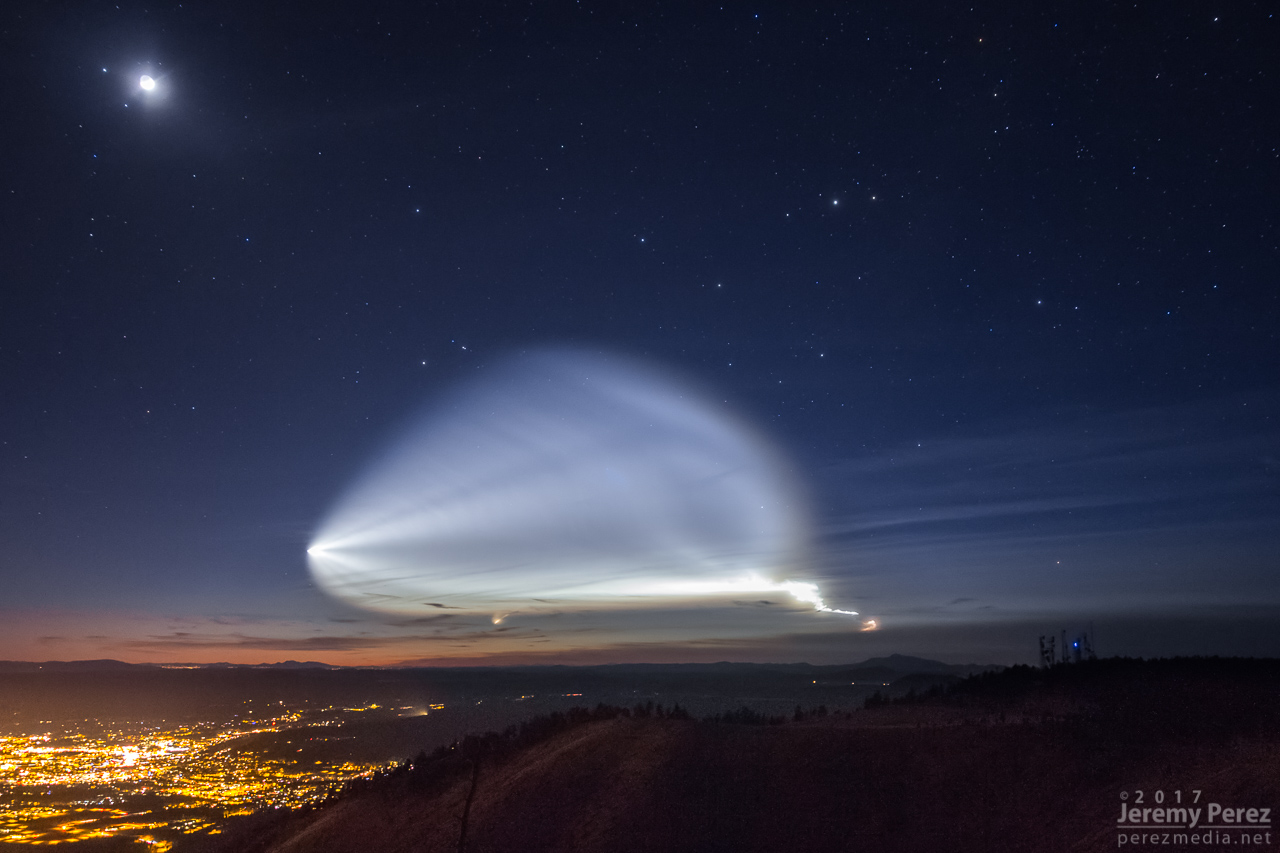
One thing I had wrongly assumed is that there would be a lot of people with radios tuned in to hear the countdown. That was not the case. When you're trying to coordinate kids and cameras, the dwindling minutes can really sneak up on you. Fortunately, some helpful individual on the other side of the field turned up the volume on their radio enough that I caught the sound of the countdown at about T minus 7 seconds. Just enough time to get the camcorder rolling and catch the first puffs of steam billowing to the south from the orbiter's engines. Five seconds later, the searing cloud from the solid rocket boosters blew out to the north, and slowly the shuttle reared into view.
It is simply awesome to watch that magnificent machine rise up on a blazing, coppery plume of fire and punch through the clouds. It arced quite a bit further north than I was expecting, so we had to shuffle around to see past the trees. About a minute later while it soared behind a cloud, the low rumble gradually grew. It wasn't as loud as I had hoped, but it still made nearby windows rattle and definitely put a polish on the experience.
Click any of the following images for larger versions.
A little more than two minutes into the flight, the SRBs gave a final gush of smoke and fell silent. To the naked eye, the smoke trail faded to nothing, while a brilliant point of light marked the continued progress of the Discovery's own engines. However, the magnified views of the camcorder and the digital camera show the fainter SRBs peeling away while still trailing the shuttle through the sky.
At two minutes and forty-five seconds into launch, that speeding star disappeared behind one final cloud, and the show was over. The kids were definitely as stoked as I was!
Shortly afterward, we had dinner in Cocoa Beach and met JoAnne whose niece Karen Nyberg was a mission specialist on the flight. She was kind enough to pose with my step mother for a quick photo. (JoAnne is the one with the NASA family member badge :-)
Below are frames from the video. I'm including them because the camcorder was able to zoom in tighter than the camera--so some of the details are easier to see.
And here is the video:
Two hundred miles for two-plus minutes. It was quick, but it was worth it!
Since I originally made this observation close to two years ago, I've been a little concerned by a few of the features I portrayed in the sketch. The elongation of unresolved stars in NGC 6520 didn't seem to be aligned correctly, and the darker tendrils surrounding B86 didn't make a great deal of sense compared to photos of the area. Before submitting the drawing for an upcoming article, I figured I better get it together and do something about those nagging concerns.
With the moon growing fuller by the moment, I had a very small window Friday morning to observe this beautiful pair between moonset at 3:10 am, and beginning of astronomical twilight at 3:40 am. So I dragged myself out of bed--I'm still positive that this is unhealthy--and drove out to Sunset Crater National Monument. Unfortunately, a storm the day before had planted a series of long-lasting orographic clouds over northern Arizona. I made a bad estimate of their extent before heading out, and ended up under a thick, unmoving blanket of cloud by the time I reached the entrance to the national park. So I turned back around and headed for a familiar spot closer to town--the Mt. Elden Trailhead parking lot.
Glare from some lights about a mile away was a problem here, but the sky was very transparent, and Barnard 86 made an attractive appearance. The extra couple inches of aperture from the 8" Dobsonian helped too. Using a tracing of the existing sketch as a template, I started marking in the boundaries the nebula's dark heart, and fainter reaches. The entire area is mottled with complex formations of Milky Way starlight. I think I could make a week-long project out of observing and illustrating this area in detail. For this observation though, I stuck to the primary structures in the view. I don't know how I missed the bright orange color to the star on the northwest edge of Barnard 86 on the original sketch, but I made sure to note it here. The nebula's trapezoidal shape was more evident this time, as I scanned its perimeter. The orientation of NGC 6520 was definitely aligned closer to 180 degrees than in my original sketch.
It wasn't long before twilight began washing the sky out. But I had what I needed and went home for a couple more hours of sleep before work. Using the revised diagram, I used the dodge and burn tools in Photoshop to touch the original sketch up to match the new observation. I think this updated illustration is truer to the visual appearance of the nebula. For reference, the previous drawing can be found below.
Object Information:
According to Star Clusters and Associations, Selected Data (Alter + 1970), NGC 6520 lies 1650 parsecs distant (5380 light years).
According to Giovanni Garraro, et. al. of the University of Chile, the cluster and dark nebula are assumed to lie at the same distance from Earth, and that this distance is actually 1800 - 2000 parsecs (5870 - 6520 light years). They estimate the age of the cluster at 100 to 200 million years. Due to the difficulty in differentiating stars in the cluster below vMag 18 from the Milky Way field, the clusters population was limited to stars brighter than this. Working from that standpoint, the cluster is given a radius from 0.5 to 1.5 arc minutes--quite a bit smaller than the value given at the NGC/IC Project. It is noted in the paper that this is not a limiting size on the cluster, which could surely be larger if stars fainter than 18th magnitude could be distinguished.
Study of imagery of the region suggests that the dark nebula envelopes the open cluster, particularly toward the south. Star counts were also made of stars in front of the cloud, compared to the number expected to lie within 1, 2 and 3 kpc from the Sun in the direction of the cloud. These counts support the assumption that both objects lie at the same distance. Still, the paper notes "this assumption must be verified in some more quantitative way, which is not possible with the present data." It was also noted that the 100 - 200 million year age of the cluster does not seem compatible with the associated molecular cloud whose mean lifetime should be more like a few tens of millions of years. If later radial velocity and infrared spectral analysis confirm the relationship, the cloud would be an interesting subject of study as it would represent a stable condensation that has lasted a full galactic rotation.
Subject
NGC 6520 and Barnard 86 (LDN 93)
Classification
NGC 6520: Open Cluster (I 2 r n) Barnard 86: Dark Nebula
May 16, 2008 - 3:45 AM MST (May 16, 2008 - 10:45 UT)
Observing Loc.
Flagstaff, Arizona
Instrument
Orion Syquest XT8 Dobsonian (203 mm dia./1200 mm F/L)
Eyepieces/Mag.
10 mm (120X)
Seeing
5/10
Transparency
5.8 + NELM
*Sources
NGC/IC Project
Star Clusters and Associations, Selected Data (Aster+ 1970) Lynds' Catalogue of Dark Nebulae (Lynds 1962) Barnard's Catalogue of 349 Dark Objects in the Sky (Barnard 1927)
Original observation: August 25, 2006
Move mouse over image to see photographic overlay these objects. Click here for a large version of the sketch (121K).
Observation Notes:
Do you like to view deep sky objects that share the view with other notable objects? Well, here is one combination you don't want to miss. Try to catch it from a dark sky if you can, so you can view it in all its rich detail. NGC 6520 is a small, foaming open cluster nestled in the midst of a sprinkled haze of Milky Way stars. Just beyond the western boundary of the cluster lies an oblong pit, denuded of starlight. This dark realm is further bounded on its western edge by a string of four bright stars posted like buoys marking the rim of a bottomless abyss. This perception of depth is of course an illusion. The inky object, Barnard 86, is really a dark nebula resting in the foreground, blocking the collective light of the Milky Way behind it.
I got my first look at this beautiful pair over six months ago at the end of an all night observing session. Earlier that particular night, I had observed and sketched a couple other dark nebulae: Barnard 34 and The Pipe Nebula. My first look at the NGC 6520/Barnard 86 combo readily showed the dark nebula as a small, oval knot. But I didn't have time to spend on the observation, and wasn't rewarded with some of the other details the view affords.
While the thickly starred low power view is stunning, these two objects benefitted from a bit more magnification. I chose to sketch at 120X. This provided a 24 arc minute wide field of view that framed them both nicely. The open cluster was elongated, and to my eye appeared to stretch northwest to southeast. As the rollover astrophoto above shows, the cluster actually appears to stretch more directly north to south. At its heart I noticed the warm light of an orange star. The dark nebula was elongated northeast to southwest and sported a sharp boundary along its western edge. Muted, dark tendrils appeared to crawl away from the nebula and merge into the surrounding Milky Way. The most prominent of these pseudopods rested along the southwestern side of the nearby open cluster. The Milky Way reached into the southwestern edge of the view with a brighter fog of starlight that enveloped a string of 10th and 11th magnitude stars.
While the view was very enjoyable, the sketch turned out to be an incredible challenge. A few days earlier, I had been tormented by passing clouds during a lengthy sketch of M8. This time, I not only had to share the view with passing clouds, but I was further enveloped by a level of humidity that was just shy of fog. In the amount of time it took me to sketch the field stars, the paper had absorbed what seemed like a washrag's worth of water and the blending stump had become rubbery. Sketching a dark nebula in the midst of Milky Way starlight requires a lot of shading. Shading even a tiny spot on moist paper is a nightmare. The paper repels graphite from the blending stump with gusto. I gave it my best shot, but by the time I had roughed in the major areas, the paper wouldn't take any more graphite. So it wasn't possible to refine boundaries, even out shading, or deepen shading anywhere I had already shaded. I had to resort to making a separate contour sketch (see below) to note where I would have to refine the dew-damaged sketch later.
The image below shows the original roughed in sketch. If you move your mouse over it, it will give a comparison of the cleaned up sketch.
The entire process made me wish I had invested in a pad of Rite in the Rain paper. Normally I don't need to worry about crippling dew, but I now realize it's a good idea to be prepared anyway for bizarre occasions such as this.
Before submitting the sketch of this double for an upcoming observing article, I noticed an obvious error in the orientation of the entire field. Whenever the alignment of the double is very close to north, south, east or west, any slop in position angle becomes pretty obvious. So I headed out early this morning for another look and put the astrometric eyepiece on it. The corrected PA and separation can be seen in the illustration above, and the info in the table below. I'm convinced that getting up at 4 in the morning is unhealthy, but the strikingly beautiful color in this double made up for it. It's very wide and definitely appears best at low power. Be sure to look it up with binoculars or a low power eyepiece when Capricornus makes its way into a more agreeable time slot later this summer.
The Washington Visual Double Star Catalog, 1996.0 (Worley+, 1996); Catalogue of Stellar Spectral Classifications (Skiff, 2007); Visual Double Stars in Hipparcos (Dommanget+, 2000); Starry Night Pro Plus 5.8
Original Observation Notes:
October 9, 2006: To help provide a consistent style for my double star sketches, the above sketch is a digital update to the original sketch.
I'm not sure if this is a triple or not. The primary is brilliant yellow-orange. The secondary is deep blue (PA 265°, Sep. 4'). The tertiary (if that's what it is) is orange (PA 160°, Sep. 5'). All elements were widely spread. The actual listed value of 267° PA/206" (3'26") sep closely matches the measure to the blue secondary.
Move mouse over sketch above to view labels. Click image for larger version.
Observation Notes:
Conditions for viewing the comet were much better tonight. Little wind, and improved transparency. As a result, the comet was easier to spot. It was still very soft, but its apparent diameter was closer to 11 arc minutes (compared to 7 arc minutes visible last night). The central condensation was a bit more noticeable as well. Still no suggestion of elongation or a tail. It still fit in the same low power view as V Hydrae, although it was not as nicely placed as the night before. The comet had moved about 50 arc minutes west-southwest since my earlier observation 24.25 hours ago.