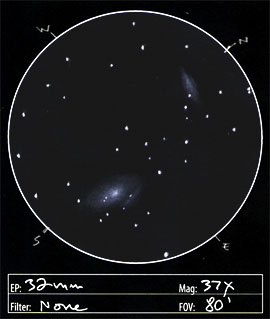
Observation Notes:
 These 2 galaxies are impressive. They were an amazing treat that fit into the same view together--big and bright.
M81 was the larger, brighter, and wider of the two galaxies, elongated north to south. It had a strongly condensed nucleus. It seemed to have a sharper edge on the west side, and had a hint of detached brightening suggesting an arm on the northwest side. There were two stars involved in the glow of the galaxy on the south side, as well as two dimmer stars in the area I think I'm seeing an arm. I would estimate its size at 20' x 10'.
M82 was slender and aligned east-northeast to west-southwest. The north side seemed to have the sharpest edge. There wasn't a distinct nucleus, although it did brighten toward the middle axis. It was brightest just east of center. Its size seemed to be about 12' x 3'. When I checked it at 120X (not sketched), it displayed an irregular mottled appearance.
Factoids:
M81 is the brightest galaxy of the M81 group. A few tens of millions of years ago, M81 had a close interaction with its neighbor M82. M81's spiral structure was effected, becoming more pronounced, as well as forming a dark linear feature northeast of the nuclear region. It's distance is estimated at nearly 12 million light years. An unusual aspect of the galaxy is that it appears to have very little dark matter, as it's rotational velocity drops off in its outer region much more than in most galaxies.
M82 lies about 150,000 light years north of M81. After its interaction with M81, M82's core has entered a period of heavy starburst with conspicuous dark lanes. Over 100 young globular clusters have been discovered as likely results of this encounter. The explosive gas flow is a strong source of radio noise, which was discovered by Henbury Brown in 1953. M82 is also the brightest infrared galaxy in the sky. As with its companion, it lies nearly 12 million light years away.
Both galaxies were discovered by Johann Elert Bode in 1774, rediscovered by Pierre Méchain in 1779 and cataloged by Charles Messier in 1781.
| Subject | M81 (NGC 3031) M82 (NGC 3034) | |
| Classification | M81: Spiral Galaxy - Type Sb M82: Irregular Galaxy - Type Ir-II | |
| Position* | M81: Ursa Major [RA: 09:55.6 / Dec: +69:04] M82: Ursa Major [RA: 09:55.8 / Dec: +69:41] | |
| Size* | M81: 21' x 10'; M82: 9' x 4' | |
| Brightness* | M81: 6.9; M82: 8.4 | |
| Date/Time | February 13, 2005 - 12:45 AM (February 13, 2005 - 07:45 UT) | |
| Observing Loc. | Flagstaff, AZ - Home | |
| Instrument | Orion SVP 6LT Reflector (150 mm dia./1200 mm F/L) | |
| Eyepieces/Mag. | 32 mm (37X); 10 mm (120X) | |
| Conditions | Clear, 31°F, breezy | |
| Seeing | 1-2/10 | |
| Transparency (NELM) | Mag 5.8 | |
| Sources | SEDS |
*Based on published data.
| Subject | M81 (NGC 3031) M82 (NGC 3034) | |
| Classification | M81: Spiral Galaxy - Type Sb M82: Irregular Galaxy - Type Ir-II | |
| Position* | M81: Ursa Major [RA: 09:55.6 / Dec: +69:04] M82: Ursa Major [RA: 09:55.8 / Dec: +69:41] | |
| Size* | M81: 21' x 10'; M82: 9' x 4' | |
| Brightness* | M81: 6.9; M82: 8.4 | |
| Date/Time | February 13, 2005 - 12:45 AM (February 13, 2005 - 07:45 UT) | |
| Observing Loc. | Flagstaff, AZ - Home | |
| Instrument | Orion SVP 6LT Reflector (150 mm dia./1200 mm F/L) | |
| Eyepieces/Mag. | 32 mm (37X); 10 mm (120X) | |
| Conditions | Clear, 31°F, breezy | |
| Seeing | 1-2/10 | |
| Transparency (NELM) | Mag 5.8 | |
| Sources | SEDS |




When I first got my 10" Meade LX50 a few years back this duo was one of the first objects I wanted to observe. It showed nicely. Prior to that I used a 60mm f/15 refractor so I was not used to seeing galaxies very well or at all. It was a dark moonless night and the pair were high in the sky. After seeing it in the 10" so well and knowing where to look I grabed my 10X50 binos and shockingly there they were and quite obvious! I then thought what if...so I found my 8X20 binos and couldn't believe my eyes, again they were there, oval and elongated! I then thought, could these possibly be naked eye objects, after all 8X20's are not much to work with. Hard as I tried, though, switching between the unmistakable view in the 8X20's and naked eye I just could not do it.
Frank, thanks for sharing your experience with this beautiful pair. As obvious as they can be through binoculars, they don't give themselves up readily to the naked eye. There are reports of keen-eyed observers extracting them from the sky with the naked eye, but it has to be an incredibly difficult feat. I haven't tried this one yet, but if I did, I would probably make use of a cardboard tube held up to one open eye, to block out extra skyglow and keep dark adaptation as acute as possible.
Jeremy