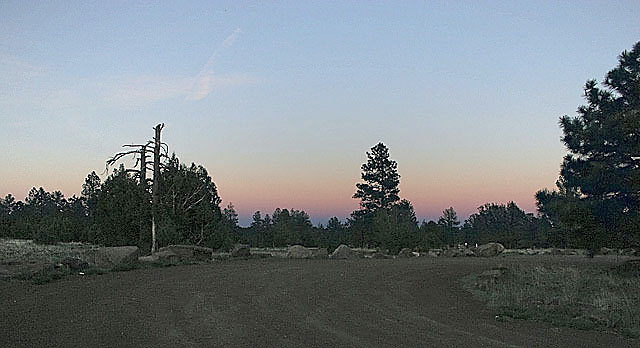
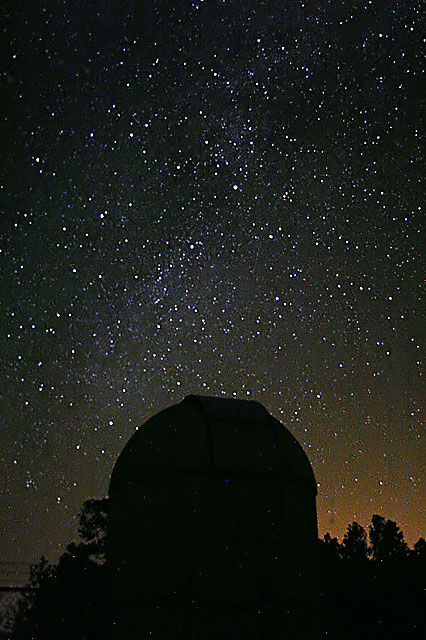
The Belt of Venus rises in the east at the Anderson Mesa observing site.
For somebody staying in Flagstaff, Anderson Mesa is a very convenient, true dark-sky observing site. From the Lake Mary Road turn, it is less than 12 miles to the site. Anderson Mesa is in the Coconino National Forest, so it is open to the public as long as there are no forest restrictions or closures. The sky above Anderson Mesa is among the clearest, darkest, steadiest, and readily accessible in the US. Visitors who arrive at the site before the sky gets too dark may enjoy a short walk down the paved observatory road to get a look at some of the Lowell Observatory facilities (the Anderson Mesa domes are otherwise closed to the public). As you spend your evening observing, you may enjoy knowing that you'll be in good company, as professional and academic astronomers are studying the sky just a few hundred yards down the road.
As with the first time visiting any unfamiliar area, arriving before dark can be very helpful in being sure you find the site. The short gravel parking area just north of the domes can comfortably accommodate four or five vehicles and telescopes. (More vehicles and observers can use the area, but it may require parking along the access road and carrying equipment to a useable spot--be sure not to block traffic.) A few nearby trees will dictate what part of sky will be hidden from view, so be sure to choose a spot that gives you the most open view of the area you intend to observe. For overall darkness, the sky to the east, south, and of course overhead, are the best since the modest Flagstaff light dome effects the northwest sky.
Because the site is near some popular campgrounds, and near town for that matter, the road to the site does suffer from vehicle traffic during the night. A convenient bend in the road and good acoustics will usually give you fair warning of approaching vehicles so you can take steps to protect your dark adaptation. Due to this vehicle traffic (and regular air traffic), astrophotographers will need to be diligent to avoid compromised exposures.
At an altitude of 7200 feet, Anderson Mesa gets cold--especially so in the winter--so observers will want to bring warm clothing no matter what time of year.
Panorama
Requires Quicktime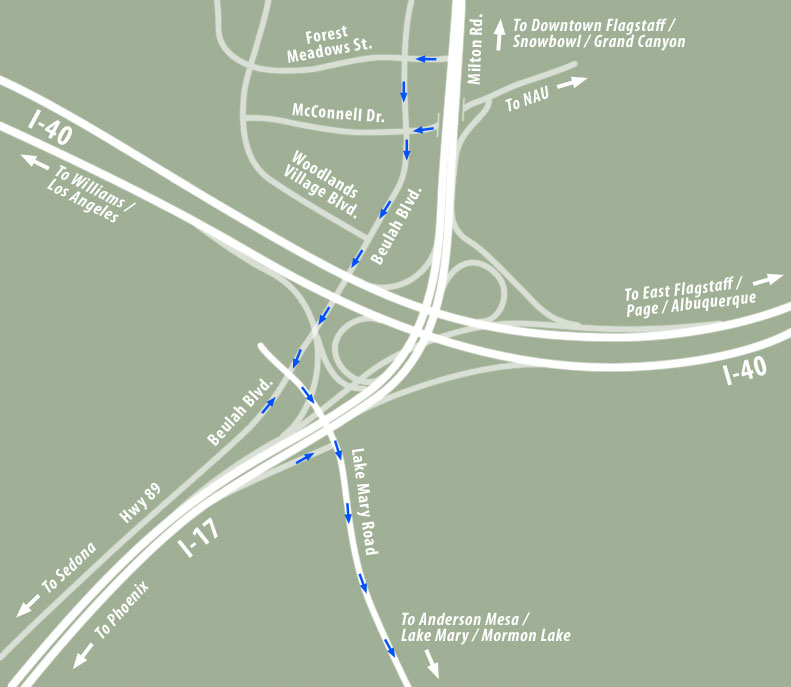
I-40 / I-17 Interchange to Lake Mary Road
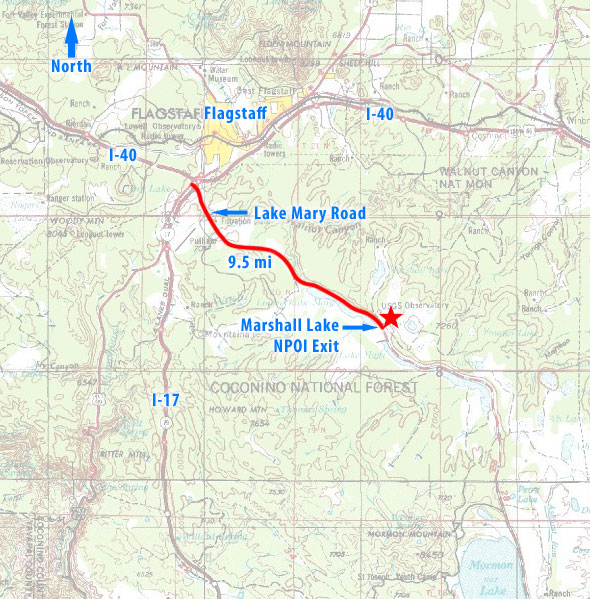
Area Topo Map
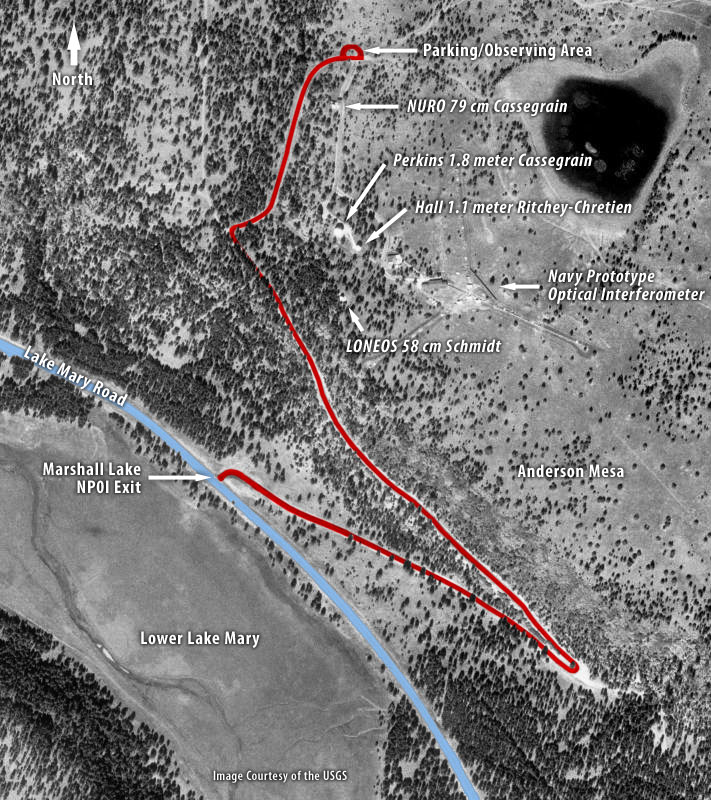
Aerial Site Photo
Site Information
| Site Name | Anderson Mesa |
| Coordinates | 35° 6' 1.5" N / 111° 32' 11.5" W |
| Elevation | 7230 ft (2203 m) |
| Directions | From the I-40/I-17 interchange, head north into Flagstaff. At the first traffic light (Forest Meadow Street) turn left. Turn left again at the next traffic light (Beulah Blvd). Go to the third traffic light (Lake Mary Rd.) and turn left. Take Lake Mary Rd. 9.7 miles and turn left just past the sign for Marshall Lake and NPOI. The observing site is 1.5 miles up the hill on the left, just before the first Lowell Observatory dome. |
| Accessibility | Easy access. Paved road all the way to the parking area. Parking area is packed cinder. |
| Capacity | Parking area easily accommodates four or five vehicles and equipment. More observers can fit tightly, or park along the access road and carry equipment to a useable spot. |
| Horizon | Some nearby trees will require strategic telescope positioning to be sure areas of interest are not blocked. More distant trees from east-southeast to southwest to northwest will roughly block 10 degrees of horizon. North and northeast horizon are very good. |
| Light Domes | Modest Flagstaff light dome is noticeable to the northwest. Much less noticeable light from Phoenix, 100 miles distant can be detected to the south. |
| Weather |
Temperature Ranges Jan: Avg. Max: 43° F / Avg. Min: 17° F Apr: Avg. Max: 58° F / Avg. Min: 27° F Jul: Avg. Max: 82° F / Avg. Min: 50° F Oct: Avg. Max: 63° F / Avg. Min: 31° F Nocturnal cold air drainage is not a problem at this site. All Northern Arizona sites are susceptible to cloudy weather during the monsoon season which runs on average from early July through mid-September. The months of May and June are on average the most reliably dry months of the year. |
| Incidental Traffic | Recreational traffic from Lake Mary, Marshall Lake, and Flagstaff itself can be a regular occurrence at night, especially during weekends. Keep your ears open for the sound of cars driving up the hill to the Mesa so that you can be prepared to protect your dark adaptation as they pass by. |
| Seeing | Seeing is typically good at this site. |
| Transparency | High elevation and typically dry air make for excellent transparency. |
| Site Assessments from Other Observers | Brian Skiff |
Photo Gallery
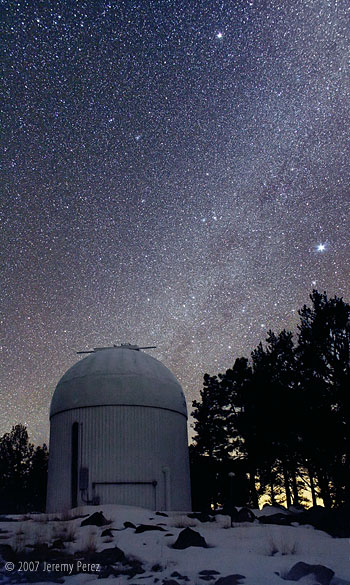
PUP-MON Milky
Way & LONEOS
[ High Res Link ]
FEB 15 2007
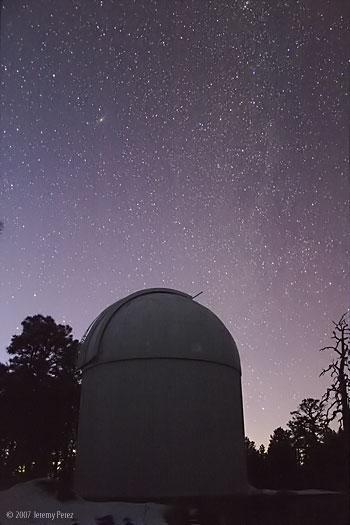
PER-LAC Milky
Way & LONEOS
[ High Res Link ]
FEB 15 2007
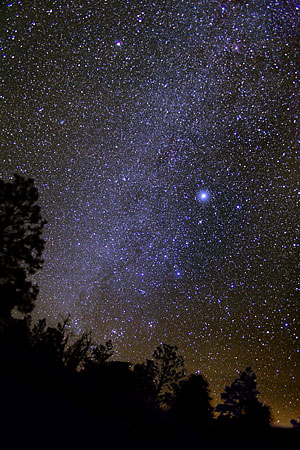
CMA Milky Way
at Anderson Mesa[ High Res Link ]
NOV 6 2005
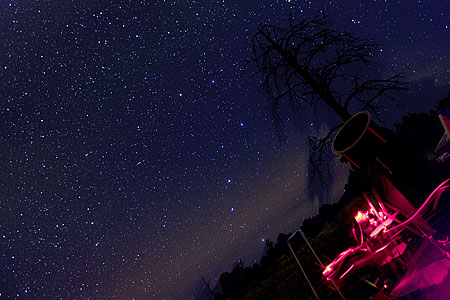
UMA Rising
at Anderson
Mesa
NOV 6 2005
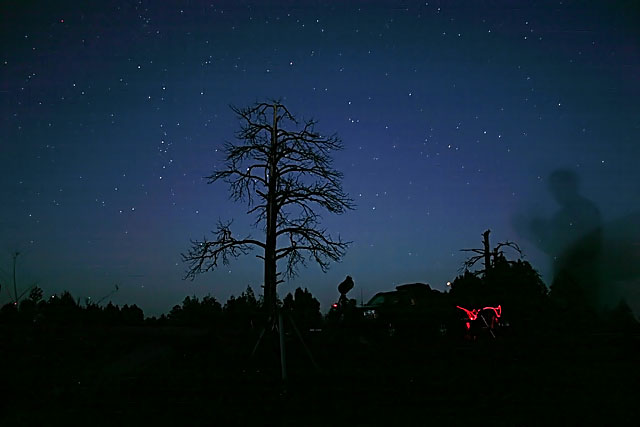
Observing and
Imaging at
Anderson Mesa
OCT 30 2005
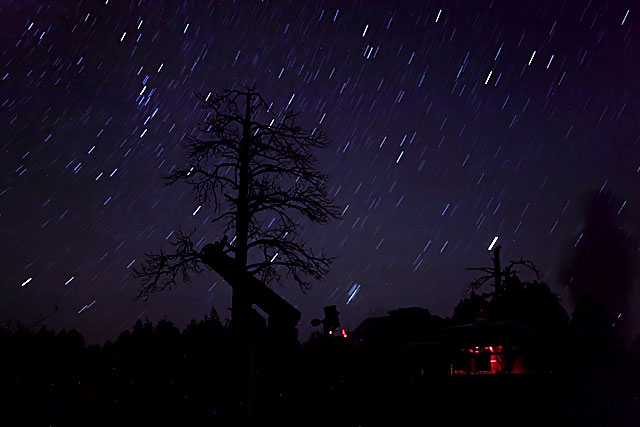
Observing and
Imaging at
Anderson Mesa
OCT 30 2005
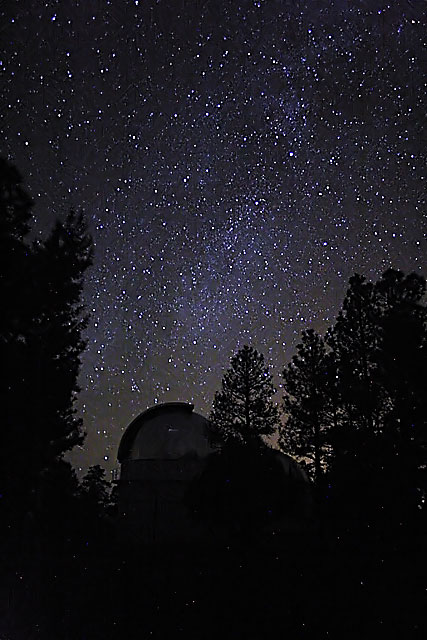
Hall Observatory
at Anderson
Mesa
OCT 30 2005
NURO Observatory
at Anderson
Mesa
OCT 30 2005
Updated July 31, 2007.




![[ High Res Link ]](images/2007/img20070215_LONEOSS1md.jpg)
![[ High Res Link ]](images/2007/img20070215_LONEOSWmd.jpg)
![[ High Res Link ]](images/2005/img2005110604_CanisMaj1024A.jpg)
Jeremy:
I will be visiting Flagstaff around June 21. My son is going to NAU this fall and both my son and I will be in town for an orientation. I would like to go up to your club's Anderson Mesa site and take some images. I was wondering if this would be OK with your club? Thanks.
Paul C
Hi Paul,
The site is on public, forest service land, so no permission is necessary. The only thing that could cause a problem is if there are fire restrictions in place--which can happen between now and mid-July. Check with the Forest Service prior to heading out, and they can let you know if that's the case. Thanks for the message, and I hope you enjoy your visit and a clear, starry night out at Anderson Mesa.
Jeremy
Jeremy:
To supplement my last email, I was on Google Maps and noticed a site about 15 miles north of Flagstaff that may be a good site to take images. It appears to be in a really dark area. The site is called Kendrick Pinic Area; I guess it is up around Kendrick Park. There is a great deal of open land there. Do you know if there are any restrictions to just going out there and set up my equipment to take images? Thanks.
Paul C
Paul, I'm very sorry I haven't responded yet. I have not checked out the Kendrick Picnic Area, but if it is on forest service land, you shouldn't have any problems--there are no forest closures so far! I would guess that observing in that area would put the Flagstaff light dome to your southeast, but that the sky should be very nice otherwise. If you observe there, please let me know how it went.
Jeremy
Jeremy:
I got a chance to view from the area up by Kendrick Park last Sunday. I was very dark (Clear Sky Chart has it as dark gray, so it is better dark. But being from the East Coast, it most places around Flagstaff seems to be "dark". I observed about 50 feet off of the pavement of the parking lot in order to get a better view of the sky. The only issue I had with this spot was there was a constant flow of cars with high beams up and down Rt 180, but other than that it was an enjoyable observing session and I got some good star field images. Thanks.
Paul, I'm glad that worked out for you. Once you get outside of town, the sky is great just about anywhere. Although it can be a bit of a pain finding a spot that doesn't get lit up if you're close to the highway. Do you ever post your images online? I'd be interested to see what you shot if you do.
Take care,
Jeremy
Jeremy:
I don't have a personal web page, so I do not really post images on line. I believe I still have your email address from a previous message and I can send some of my images to you if you like. Some are quite large (46M) though, because after I shoot with my Canon 30D, I like to convert them to a loseless TIFF file.
Paul
Jeremy:
To supplement my last comment to you (back in July) on your web site, I added some of my images (if your still interested in seeing them) on my club's web page (www.atmob.org). Click on the GALLERY button and look for Images from the WBY Observatory. Thanks.
Paul C
I observed Comet Hyakutake from this site. Awesome, best Astronomical vision of my life. I was a member of the NAU astromomy club and we went to a site around the Hochderffer Hills area north of Flagstaff. It was off to the right of Highway 180 about 15 miles North of Flagstaff. We went up some dirt road up to the top of the small mountian or large hill. It was a great observation site that farther away from Flagstaff's lights. Now I live in Ohio and observation is terrible here.
I wish I had been actively observing when Hyakutake swept by. I only viewed it from in town--which was still awesome--but it would have been incredible from a dark site. Brian Skiff pointed me to a site north of Kendrick Peak on Hwy 180 called Bull Basin Mesa that he and Chris Lughinbuhl used when observing objects for their Observing Handbook. It sounds like it was pretty close to the site you used, although it was west of the highway. I scouted forest roads around the area a couple years ago in daylight, but have yet to use it for observing. It looks like a great location. Being set up on a hill was probably nice for staying above any nocturnal cold air drainage from the peaks. I hope you find some opportunities to get out to a dark, transparent site soon!
Jeremy: My daughter lies in Kachina 10 miles south of Flag. She is a graduate of NAU and works in the OR of Flagstaff hospital. I come to Flag 4 or 5 times/ year. I have an 18" f 7.5 Ritchey Chretian Cassegrain ground by Dave Dodgen of Flag. many years ago. His son Rod now runs the optical business in Flag. I am looking for a dark site that the telescope can be placed remotely and could also be used by others. The tube assembly will be placed on a Bisque ME 2 mount and be used for serious imaging and photometry. Does the club have such a site ? What would you recommend ? I live outside LA and we have 5th magnitude skies here.
Thanks Telescope Mike
Hi Mike, that sounds like a magnificent scope! I used to work across the parking lot from RC Optical a few years ago. Although I never actually met Rod.
The Coconino Astronomical Society doesn't own or lease any land that I'm aware of. However, some of the club members may know of some good options. I haven't been active with the club recently. If you send an email to info@coconinoastro.org, the board may have some leads for you. Please let me know if you have any difficulty reaching them.
I hope you enjoy your next visit and have an opportunity for some nice dark sky observing.
Jeremy