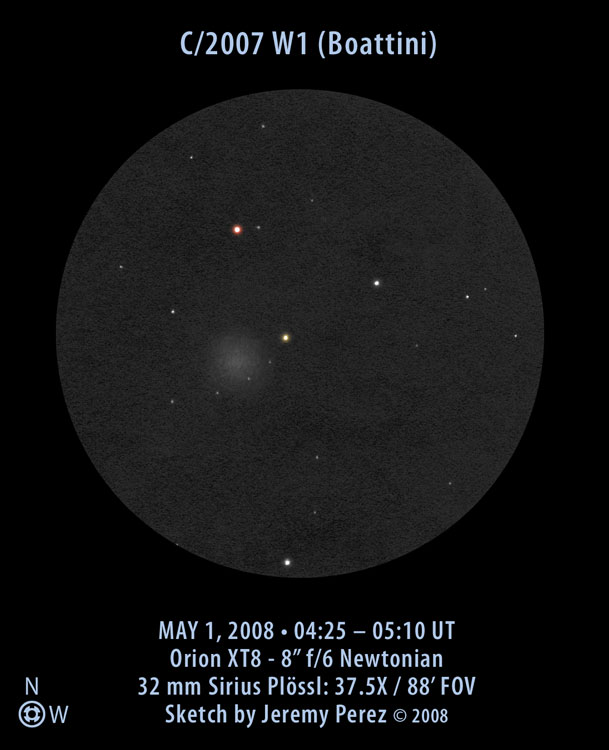
Move mouse over sketch above to view labels. Click image for larger version.
Observation Notes:
Although this comet would have benefited from a trip outside of town to get away from the low altitude light pollution, I was still able to find it from my front yard. The comet showed up as a very gradual brightening with a very subtle concentration at the core. It is a slow mover, so I was only able to track about 2 arc minutes worth of movement over the 45 minute span I noted its position. After that, it had sunk too far into the southwestern light pollution to observe further. The best part of the observation was the beautifully red carbon star that shared the low power field with the comet. I couldn't resist researching its identity (V Hydrae) and sketching what turned out to be a double star with a carbon star as its primary: V HYA (BU 1428).
| Subject | C/2007 W1 (Boattini) | |
| Classification | Comet | |
| Position* | 05:25 UT - Hydra: [RA: 10:51:43.8 / Dec: -21:34:29] 06:10 UT - Hydra [RA: 10:51:36.5 / Dec: -21:34:45] | |
| Size | Coma: 7 arc minutes diameter | |
| Brightness* | ~ 8.0 vMag | |
| Date/Time | April 30, 2008, 9:25 - 10:10 PM (May 1, 2008, 04:25 - 05:10 UT) | |
| Observing Loc. | Flagstaff, AZ - Home | |
| Instrument | Orion SkyQuest XT8 Dobsonian | |
| Eyepieces/Mag. | 32 mm Sirius Plossl (37.5X) | |
| Conditions | Clear, gusty winds | |
| Seeing | 4/10 Pickering | |
| Transparency | Mag 4.5 NELM | |
| *Sources | Aerith.net; Starry Night Pro Plus 5.8 |
*Based on published data.







5-18-08
Dear Sir:
I have been doing some research on this comet C/2007 W1 Boattini and its suppose to have a 5.8mag in the middle of june. I plan to use my 10X50 Binoculars to find it. I live at the very se of MI
The town is called Monroe.
Hi Harry, at 6th magnitude or better, the comet would be a nice target for binoculars. The problem is that it is heading south and even now, it is very low in the southwest. From your latitude now, it is about 6 degrees above the southwest horizon at the end of astronomical twilight, and getting lower by more than a degree per day. Within a few days, it is going to be visible only to observers in the southern hemisphere.
It will reappear in the early morning sky for northern hemisphere observers in early July. By July 11, it will be about 10 degrees above the eastern horizon at the beginning of dawn astronomical twilight (in the constellation Cetus). If getting up before dawn works for you, this might be a nice time to observe it--although the moon may be a problem. You may have already checked Aerith.net, but just in case, this link will take you to finder charts for the comet: Aerith.net C/2007 W1 Page. I hope you get a chance to observe it.