Step 8 - Adding Additional Glow
This last step is a bit of a personal preference. I like to add an additional soft glow around brighter stars to enhance the sense of brilliance. To do this, select a soft brush that is 2 to 3 times the diameter of the star. Set it to 'Screen' mode at a very low opacity of around 5 or 6%, and click over the star a few times. You should notice a large but subtle brightening begin to form around the star (see Figure 16). As you continue to click, this glow will get brighter (see Figure 17). Be careful not to take it too far. The fainter the star is, the smaller you will want the paint brush to be, and the fewer times you will need to click the color in (see Figure 18).
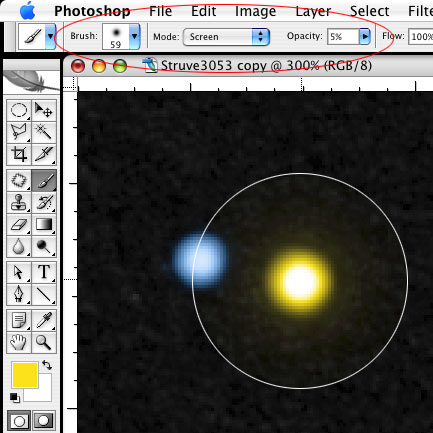
Figure 16
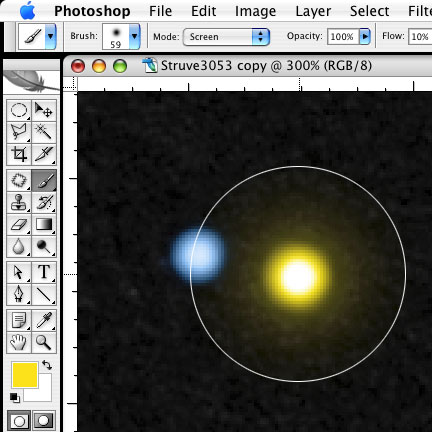
Figure 17
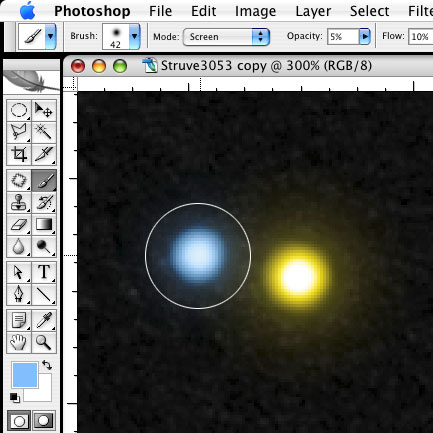
Figure 18
Once you are done with this step, you can back up to a 100% view and see how it looks (see Figure 19).
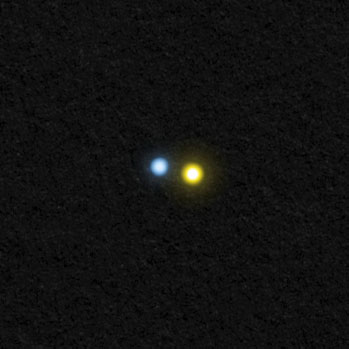
Figure 19
FInally, you can add any additional details to the sketch, such as cleaner cardinal direction markers and other details about the sketch. With that taken care of, your sketch is finished (see Figure 20).
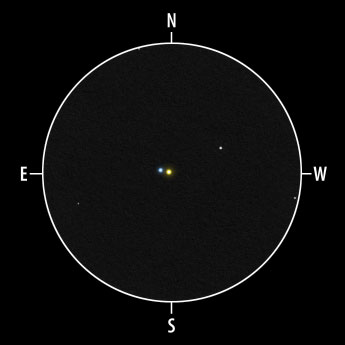
Figure 20
Be sure to check out this post at Cloudy Nights. It discusses double star sketching and contains an excellent, illustrated tutorial by Eric Graff showing the methods he uses to digitally prepare colored double star sketches.
PAGE 4 OF 4
-- First Page | Previous Page --




Excellent article: very informative/illustrative. Since the dawn of digital astrophotography (and the "down" of equipment prices too), people have abandoned the art of sketching what they see at the eyepiece without realizing that they are missing a lot. Sketching is the best way to train your eyes to astronomy; you learn to distinguish and detect even the smallest detail or variation viewable in other planets' surfaces or atmospheres, as well as in galaxies and nebulas. Of course, that's also a great strategy to learn to detect the colors of the stars. The best complement for a telescope isn't a good eyepiece, but a well trained eye.
Well said, Juan. Thanks very much for the comment. The inclusion of sketches with the Messier/Deep Sky entries at your site is very nicely done. Be sure to check them out folks: Messier Entries / Deep Sky NGC/IC.
Thank you for preparing this tutorial, it is very informative. Do you have any suggestions for capturing diffraction rings? I note that your detail sketches include these. Do you sketch the rings at the eyepiece (drawing such subtle concentric circles freehand is extremely challenging), or are they added in during the digitizing process using your notes?
Hi Ian,
In addition to my wide view sketch, I make an additional high-magnification drawing of close doubles. I draw in a representation of how the diffraction pattern looked, including how many rings were lit for each component, and how complete or tattered looking they were depending on seeing conditions. I use this rough sketch to create a digital version in Photoshop.
To help make the process efficient and keep things consistent, I've created a template of a 'perfect' diffraction pattern out to 3 rings. I then mask and distort the pattern or brush in extra spots and flecks based on my sketch and notes. For brighter stars I also add some glare and distort this to try and mimic the buzzing appearance of a bright star rippling in the eyepiece.
This whole part of the process is actually pretty tedious and it's one of the reasons it takes me so long to get my double star observations posted. :) I'm still fiddling with it.
Sometimes I wonder whether it would just be quicker to draw the entire effect in pencil and leave it at that, but I'm kind of attached to how they've been turning out so I probably won't be dropping the process any time soon.
At the very least, I'd suggest drawing a rough representation of what you saw in the diffraction pattern since it's a notable part of the observation. To help refine it, it's possible that a plastic circle template may help to at least provide consistent ring shape & size and then you can use it to pencil in either full rings or arcs.
I may try to experiment with some less tedious methods, see what happens, and write up some suggestions. Thanks for asking about it!
Jeremy
Hi Jeremy,
Well, your results are outstanding, so I would not consider other methods, less tedious or not! I agree with you completely that the diffraction pattern is an essential aspect of the observation, in particular when the secondary sits on one of the primary's rings/arcs.
I'm about to give double sketching a shot, and your tutorial and advice here will be most helpful. If you ever do get a chance to elaborate on the process you use for the diffraction pattern I would welcome that heartily.
I might start out with some lower magnitude pairs. These should only show one ring in a refractor, making the subtlety of the pattern slightly less challenging to capture.
Thank you,
Ian